
For this next artist research, I decided to choose Camille Utterback and her brilliant work with interactive installation. Camille Utterback is an internationally acclaimed artist and is considered a pioneer of installation art. Utterback studied and maintained her BA at Williams College and earned her masters at Tisch School of the Arts in New York. Utterback’s work mainly focuses on connecting computational systems with human interaction in very visually appealing ways and has been featured in a multitude of art galleries and museums including the Smithsonian American Art Museum.
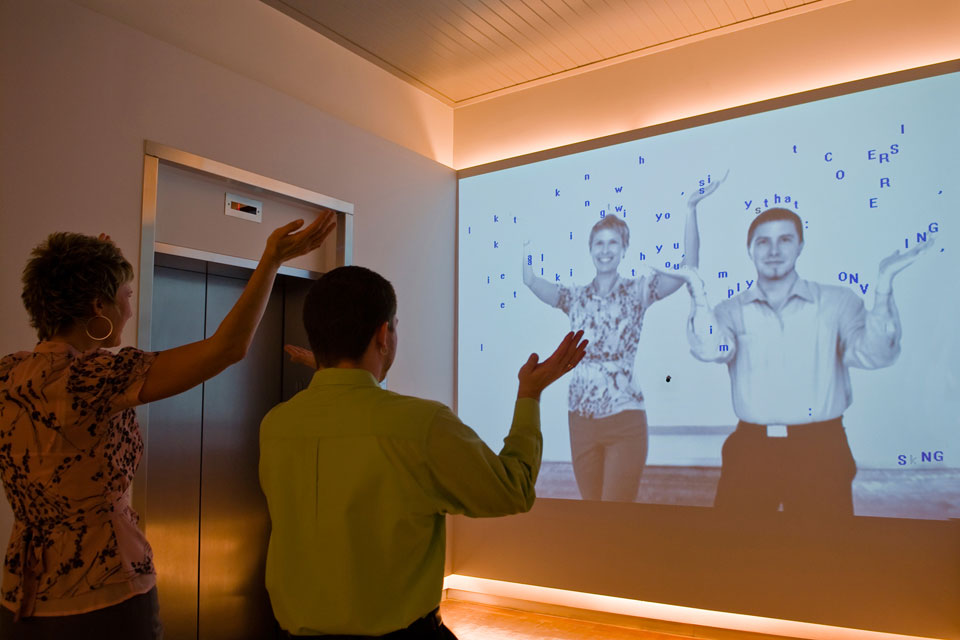
She has a lot of very cool projects, but the one that I found the most interest in was her “Text Rain” installation. In this installation, viewers are projected (in black and white) in front of a screen of falling text. The text is programmed to fall and land on objects that are darker then the screen so therefor end up falling on the person being projected. It creates a very cool and installation that is always different with each viewer being projected. I think when talking about installation art, interactivity plays (or should play) such a huge role. When thinking about all of the objectives that an art piece should achieve, I think one of the main ones would be how long a viewer stays on a piece. With something as interactive and unique as “Text Rain,” the user experience with it will almost always be a fascination resulting in each viewer to stay on the piece for a longer amount of time. I find this aspect of the art so intriguing.
Artist Statement:
Utterback’s statement is pretty long, so I’m just going to post an excerpt from it. The whole statement can be viewed here:
“My work is an attempt to bridge the conceptual and the corporeal. How we use our bodies to create abstract symbolic systems, and how these systems (language for example) have reverberations on our physical self is a matter of great concern to me. The dialog between these two realms is the subject of both my traditional and interactive work, and it is particularly relevant to our contemporary culture as we aim to grapple with the ramifications of virtuality and our increasing relationship with the interfaces and representational systems of our machines. ”